What Happens When Your Damages Exceed the Other Driver's Policy Limits?
It is one of the most common and most frustrating discoveries in a Nevada injury claim: your medical bills alone are $60,000, and the driver who hit you carries the state minimum, $25,000 in bodily injury coverage.
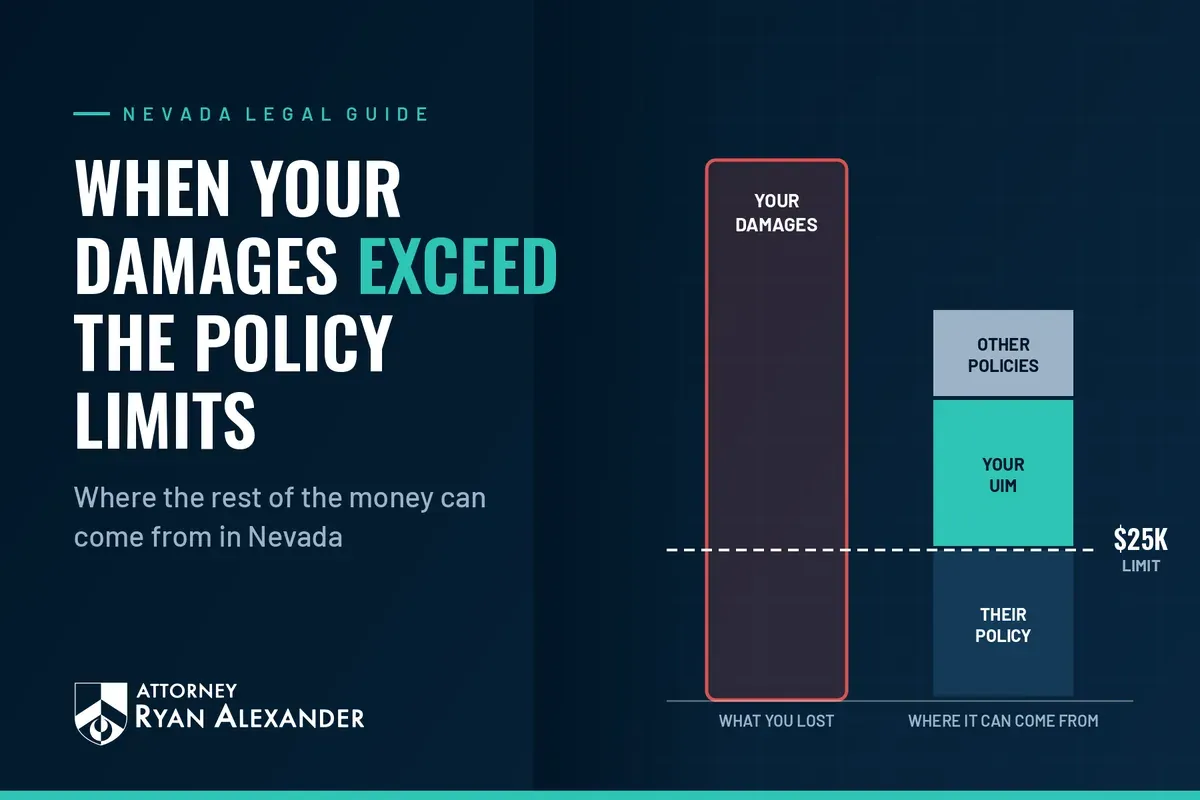
That gap does not end your claim. It changes its shape. Here is what actually happens when damages exceed the at-fault driver's policy limits, and where the rest of the money can realistically come from.
First, What "Policy Limits" Means
A liability policy pays up to a fixed ceiling, its limits. Nevada's minimum is $25,000 per person and $50,000 per accident for bodily injury (NRS 485.185), so a minimum-limits driver who seriously injures one person exposes their insurer to at most $25,000, no matter how large the damages are.
The insurer's obligation stops at the limit. The driver's legal liability does not. Those are different things, and the space between them is where this area of practice lives.
Step One: The Policy-Limits Demand
When damages clearly exceed the limits, the standard move is a policy-limits demand: a documented offer to settle the claim against the driver for the full policy limit, within a set time. Insurers take these demands seriously because of what sits behind them.
If an insurer refuses a reasonable opportunity to settle within its limits and a jury later returns a verdict above those limits, the insurer can face bad-faith exposure for the excess. That risk is the main reason clear-liability, high-damage cases often settle at limits without a trial.
Step Two: Your Own Coverage, UM/UIM
The most reliable second source is the coverage you bought yourself. Underinsured motorist coverage (UIM) exists for exactly this situation: the at-fault driver's limits are real, but too small. Your UIM can pay the difference between their limits and your damages, up to your own UIM limit.
Related: What Is UM/UIM Insurance in Nevada?
This is also why the earlier question, how much UM/UIM you carry, matters so much in Las Vegas, where minimum-limits drivers are everywhere.
Step Three: Other Policies and Defendants
A thorough investigation does not stop at one policy:
- additional and umbrella policies covering the at-fault driver or their household
- an employer's commercial policy, if the driver was working when the crash happened
- rideshare coverage, which changes by the driver's app status
- other potentially responsible parties, such as a vehicle owner who lent the car, or in the right case a bar or a manufacturer
Related: The Ultimate Guide to Nevada Personal Injury Law
Step Four: The Driver's Own Assets, Realistically
An excess judgment against the driver personally is legally available. Collecting it is another matter. Most minimum-limits drivers have limited reachable assets, and wages and homes have legal protections. An experienced attorney investigates assets before recommending you spend years chasing them, and weighs a certain policy-limits settlement, plus your UIM, against an uncertain excess recovery.
The Practical Order of Operations
In most excess-damages cases, the recovery is assembled in layers: the at-fault driver's limits first, then your UIM, then any additional policies the investigation finds, with medical liens negotiated down at the end so more of the total stays with you.
Related: How Personal Injury Settlements Work in Nevada, Step by Step
Facing a Low-Limits Driver in Nevada?
If your bills already exceed the other driver's coverage, the worst move is accepting the limit and signing a release before anyone has checked your own policy and the other possible sources. Attorney Ryan Alexander and his team can map every policy that applies to your crash before anything is signed.
Free Case Evaluation (702) 333-8888
This article provides general information and does not constitute legal advice. Every accident is different, and different claims may involve different deadlines, insurance policies, and legal issues.