The Ultimate Guide to Nevada Personal Injury Law
If you were hurt because someone else was careless, Nevada personal injury law is the system that decides what happens next: who pays your medical bills, how your lost wages are recovered, and how long you have to act before your rights expire.
This guide pulls the whole picture together in one place. It covers what personal injury law is, how fault works in Nevada, the deadlines that control your case, the damages you can recover, and how a claim actually moves from accident to resolution. Individual topics are covered in depth in the linked articles throughout.
What Is Personal Injury Law?
Personal injury law covers claims where a person is physically injured, and sometimes suffers property damage, because of another party's negligence or wrongful conduct.
The most common Nevada personal injury claims involve:
- car, truck, and motorcycle accidents
- pedestrian and bicycle accidents
- slip and fall and other unsafe-property injuries
- dog bites
- defective products
- medical malpractice, which follows its own specialized rules
- wrongful death claims brought by surviving family members
Most of these claims share the same legal foundation: negligence.
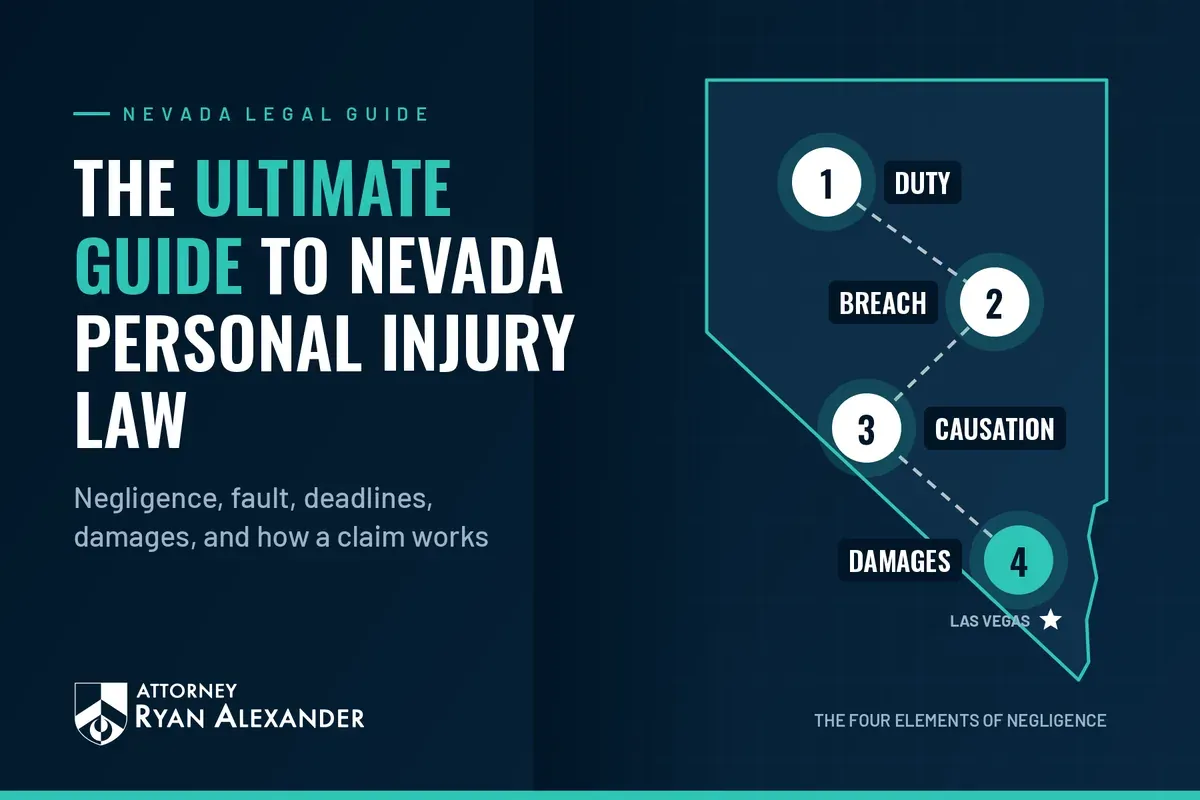
The Four Elements of Negligence
To recover compensation in a negligence claim, four elements generally must be shown:
- Duty. The other party owed you a duty of care. Drivers owe it to everyone on the road. Property owners owe it to visitors. Dog owners owe it to the people their animals encounter.
- Breach. The party failed to act with reasonable care, for example by speeding, running a red light, or leaving a known hazard unaddressed.
- Causation. The breach actually caused the accident and your injuries.
- Damages. You suffered real losses, such as medical bills, lost income, or pain and suffering.
Every piece of evidence in a claim, from the police report to your medical records, exists to prove or dispute one of these four elements.
Related: What to Do After a Car Accident in Las Vegas: 10 Steps That Can Protect Your Claim
Nevada's Comparative Negligence Rule
Nevada is not an all-or-nothing state.
Under NRS 41.141, an injured person can still recover damages when they were partly at fault, as long as their share of fault is not greater than the combined fault of the defendants, meaning 50% or less. The recovery is reduced by the injured person's percentage of fault.
So if your damages are $100,000 and you are found 20% at fault, your recovery is reduced to $80,000. If you are found 51% at fault, you recover nothing.
This rule is why you should never assume a claim is hopeless because you may have made a mistake, and why fault arguments from insurance companies deserve close scrutiny. Every percentage point they shift onto you comes directly out of your recovery.
Related: What If I Was Partially at Fault for a Car Accident in Nevada?
The Nevada Deadline: Two Years for Most Injury Claims
Nevada generally gives an injured person two years from the date of the injury to file a personal injury lawsuit based on negligence (NRS 11.190(4)(e)).
Key points about that deadline:
- It is a filing deadline for a lawsuit, not a deadline to finish your claim. But claims that are not settled as it approaches usually must be filed in court to protect them.
- Different claims can have different deadlines. Property damage claims generally carry a longer period, while medical malpractice follows its own shorter, specialized rules, and claims against government entities involve special notice requirements and damages caps.
- Waiting is costly even when the deadline seems far away. Witnesses become harder to find, video is overwritten, vehicles are repaired, and memories fade.
Related: How Long Do You Have to File a Car Accident Claim in Nevada?
What Damages Can You Recover?
Nevada law allows an injured person to pursue two broad categories of damages.
Economic damages are the measurable financial losses:
- past and future medical bills
- lost wages and lost earning capacity
- property damage
- out-of-pocket costs caused by the injury
Noneconomic damages compensate for the human losses that do not come with a receipt:
- physical pain
- emotional distress
- loss of enjoyment of life
- scarring and disfigurement
- loss of companionship in wrongful death cases
Nevada generally does not cap compensatory damages in an ordinary personal injury case. Medical malpractice is the major exception: it carries a statutory cap on noneconomic damages that most other injury cases do not have.
How a specific case is valued depends on the severity and permanence of the injuries, the clarity of fault, the treatment required, and the insurance available.
Related: How Much Is My Car Accident Case Worth in Nevada?
The Insurance Reality: Minimum Coverage Is Low
Every Nevada driver must carry liability insurance, but the legal minimum is only $25,000 per person and $50,000 per accident for bodily injury, plus $20,000 for property damage (NRS 485.185).
Serious injuries routinely exceed those limits. That is why a real claim investigation looks beyond the at-fault driver's policy to other possible coverage: additional household policies, employer or commercial policies when a work vehicle is involved, rideshare coverage, and your own uninsured and underinsured motorist coverage.
Related: What Is UM/UIM Insurance in Nevada?
How a Nevada Personal Injury Claim Moves Forward
Although every case differs, most claims pass through the same stages:
- Medical treatment and documentation. Your injuries are diagnosed and treated, and the records created become the foundation of the claim.
- Investigation. Reports, photographs, video, witness statements, and insurance policies are gathered and reviewed.
- Demand. Once your condition and losses can be documented, a demand is presented to the insurance company with the evidence supporting it.
- Negotiation. The insurer evaluates the claim and the parties negotiate. Many claims settle here.
- Lawsuit, if needed. If the insurer will not pay a fair amount, a lawsuit is filed. Many filed cases still settle, sometimes through mediation, before any trial.
- Resolution and disbursement. Settlement funds are distributed according to your fee agreement, with case costs and medical liens resolved, and the balance paid to you.
Related: How Do Personal Injury Lawyers Get Paid? Contingency Fees Explained
Do You Need a Lawyer for a Nevada Injury Claim?
Not every incident requires one. A minor property-damage claim with no injury can often be handled directly.
An attorney becomes important when injuries are significant, fault is disputed, the insurer is shifting blame, multiple vehicles or policies are involved, the other driver is uninsured, or a deadline is approaching. In those situations, the value of the claim usually turns on evidence and negotiation, and both are the firm's daily work.
Related: How to Choose a Personal Injury Lawyer in Las Vegas: 5 Questions to Ask Before You Hire
Start With Your Specific Situation
Guides explain the system. They cannot evaluate your accident, your injuries, or your deadlines.
Attorney Ryan Alexander and his team can review what happened, identify the rules and deadlines that apply to your claim, and explain your options before the two-year clock or lost evidence narrows them.
Free Case Evaluation (702) 333-8888
This article provides general information and does not constitute legal advice. Every accident is different, and different claims may involve different deadlines, insurance policies, and legal issues.